
India and Australia have signed significant agreements covering civil nuclear energy, maritime security, and critical minerals, reinforcing their partnership's role in ensuring a peaceful Indo-Pacific. The pacts facilitate uranium supply from Australia to India and enhance cooperation in defence, cyber, and critical technologies.
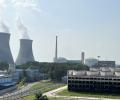
Government sources said amendments were being considered to the Atomic Energy Act to allow private sector participation and the Civil Liability for Nuclear Damage Act to limit the liability on suppliers of equipment to build atomic energy plants.

India and Canada solidify their partnership with a landmark uranium supply agreement and discussions to finalise a comprehensive economic partnership, signaling stronger ties and cooperation on key global issues.

Poland's Secretary of State, Wladyslaw T Bartoszewski, has credited Prime Minister Narendra Modi with preventing Russian President Vladimir Putin from using tactical nuclear weapons in Ukraine in late 2022, highlighting Modi's significant influence on the Russian leader.

India and Russia are expected to unveil a major nuclear energy partnership during Vladimir Putin's visit, potentially involving Russian small modular reactors and expanded cooperation as India pushes toward its 100-GW nuclear goal by 2047.

The operator's liability in the case of an incident is limited to 3,000 crore for reactors with thermal power above 3,600 Megawatt; 1,500 crore for reactors with thermal power between 1,500 Mw and 3,600 Mw; 750 crore for reactors with thermal power between 750 Mw and 1,500 Mw; 300 crore for reactors with thermal power between 150 Mw and 750 Mw; and 100 crore for reactors having thermal power up to 150 Mw, fuel cycle facilities other than spent fuel reprocessing plants and transportation of nuclear materials.

The United States and India are on the verge of finalising a landmark bilateral trade deal, aiming to boost trade to USD 500 billion by 2030, according to US Deputy Assistant Secretary of State Bethany Poulos Morrison. The agreement seeks to open India's 1.4 billion-strong market to American goods on reciprocal terms, with ongoing high-level discussions to recalibrate the pact after recent changes in US tariff policy.

Amidst global energy market volatility driven by the West Asia crisis, Russia has proposed increasing its crude oil and natural gas supplies to India, strengthening bilateral energy ties and aiming for USD 100 billion in annual trade by 2030.

The agreement provides for extensive cooperation in the civil nuclear energy sector including in research and development for peaceful uses of nuclear energy, they said.

Top leaders from the US, Iran, and Pakistan, along with other nations, have gathered in Switzerland for high-level talks aimed at restoring peace in West Asia. These negotiations follow a recently signed Memorandum of Understanding between the US and Iran, initiating a 60-day window for a deal. Discussions focus on Iran's nuclear programme and the fragile interim peace deal, amidst renewed tensions and the fluctuating status of the Strait of Hormuz.

The harsh truth is that the US is no longer a reliable partner, cautions Ramesh Menon.

India and Israel have elevated their relationship to a special strategic partnership, focusing on enhanced cooperation in trade, technology, and defense, while also addressing regional peace initiatives.

Russian President Vladimir Putin is set to visit China for talks with Chinese leader Xi Jinping, shortly after US President Donald Trump's visit to Beijing. The visit underscores the close strategic ties between China and Russia amid global tensions.

India and Canada are negotiating a long-term uranium supply agreement worth $2.8 billion. They are also exploring expanded civil nuclear cooperation after the passage of the SHANTI Bill.

The RusBeam 2800 is now India's largest electron-beam wire deposition 3D printer operating under vacuum. The machine was custom-built for India and is operated with software developed by Rosatom.
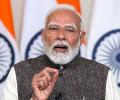
India on Saturday announced plans to amend its nuclear liability law and set up a nuclear energy mission, a move that came ahead of Prime Minister Narendra Modi's likely visit to the United States.
Ushering in reforms, Union Finance Minister Nirmala Sitharaman on Saturday proposed to open up the nuclear power sector for private players and announced a Rs 20,000 crore Nuclear Energy Mission for research in the field, with an aim to set up five small and modular reactors by 2033.

For India, much is at stake: Crucial energy supplies traversing the Strait of Hormuz, the fate of its 10 million citizens living and working in West Asia -- who send generous remittances home -- and its major trade links with the region.

US President Donald Trump and Chinese President Xi Jinping met in Beijing to discuss a range of issues, including trade frictions and the war in Iran.

Over the years, India-EU ties have grown, and covered trade, investment, climate change, science and technology, space, digital, mobility, and connectivity.

Sustaining 8 per cent-plus growth rates is necessary if we are to reach high-income status by 2047, points out Amitabh Kant.

Addressing a joint media event with Macron, Modi said the two countries have robust cooperation in the fields of defence and security.
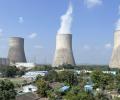
In a significant move, the United States on Wednesday removed restrictions on three Indian nuclear entities, over a week after National Security Advisor Jake Sullivan announced that Washington was finalising steps to 'remove' hurdles for civil nuclear partnership between Indian and American firms.
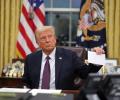
US President Donald Trump signed the National Defence Authorisation Act for Fiscal Year 2026 into law, highlighting broadened engagement with India and addressing the challenge posed by China in the Indo-Pacific region.
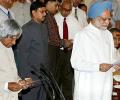
The landmark India-US civil nuclear deal of 2008, brokered during Manmohan Singh's tenure as Prime Minister, is seen as a crowning achievement in his foreign policy legacy. The agreement ended India's nuclear isolation, fostered a strategic partnership with the US, and opened doors to advanced technologies and defense cooperation. This historic deal also laid the groundwork for India's engagement with the global nuclear community.
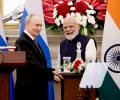
India and Russia have solidified a five-year plan to enhance their economic and trade partnership, while also addressing the ongoing conflict in Ukraine and the threat of terrorism.
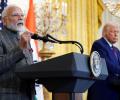
Prime Minister Narendra Modi said on Thursday that India and the United States have set a $500 billion target for bilateral trade by 2030 and added that the teams of two nations will work together to finalise a mutually beneficial trade agreement.

'Our diplomacy should have been focused on preventing war and avoiding the inevitable disruptions it would cause, posing a real risk to India's growth story,' asserts former foreign secretary Shyam Saran.

Alliances fight wars effectively only when they share an endgame. If Israel acted without US knowledge, then the military alliance is operating without real coordination at the level of strategic targeting. Neither picture is reassuring in a war that is no longer regional in its consequences. Prem Panicker continues his must read daily blog on the Gulf War.

Karex, the Malaysian company that makes roughly one in five of the world's condoms -- about five billion a year, supplying Durex and Trojan among others -- announced this week that it is raising prices by up to 30 percent. The reason is the Strait of Hormuz.
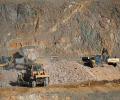
Western Coalfields Limited (WCL) has discovered significant concentrations of rare earth elements and critical minerals in its mines in Maharashtra, potentially transforming waste material into revenue-generating resources and diversifying the company's business.

The intriguing bit is that Trump is likely to attend the talks in Islamabad this weekend -- if he does, it will be the clearest signal yet that the US is ready to exit the war with some sort of win to show, since he cannot afford to go for the talks and return empty-handed, notes Prem Panicker in his must read blog on the Iran War

Under the defence partnership, India and the UAE are eyeing defence industrial collaboration and cooperation in advanced technologies, cyberspace training, special operations, interoperability of their militaries and counter terrorism.

Russian President Vladimir Putin will make a two-day visit to India from December 4 to hold annual summit talks with Prime Minister Narendra Modi that is expected to produce a plethora of significant outcomes, including in the defence sphere, to further solidify the bilateral strategic ties.

Pakistan's Prime Minister Shehbaz Sharif has offered to mediate between the US and Iran to de-escalate the ongoing conflict in West Asia, following a joint US-Israel attack on Iran. Sharif has been in contact with Saudi Arabia, the UAE, and other nations to promote dialogue and diplomacy.
Pakistan's Prime Minister Shehbaz Sharif has engaged in extensive diplomatic efforts to de-escalate the conflict in West Asia, offering to host talks between the US and Iran and engaging with leaders from Saudi Arabia, Qatar, Malaysia, the UK, China, and the European Union.
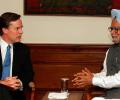
The India-US nuclear deal was aimed at ending India's nuclear isolation and nuclear apartheid, recalls Rup Narayan Das.

India on Tuesday said cooperation in peaceful uses of nuclear technology is an important pillar of the multifaceted cooperation with Russia, which offered help in building small tropical nuclear power stations.

Whether the ambitious targets are achievable is a moot question as India's earlier target was 20,000 MW of nuclear power by 2020.

On the table are additional batches of S-400 surface-to-air missile systems from Russia, which India used with immense success during Operation Sindoor. India could buy at least two squadrons of Su-57 fighter jets plus joint production of S-500 air defence systems.
